What Is a Tongue Tie?

Mother breastfeeding newborn while receiving professional feeding support

Understanding tongue tie, how it can affect breastfeeding and bottle feeding, how it is diagnosed and what your options are

If you've been told your baby may have a tongue tie, you may suddenly find yourself trying to understand a whole new vocabulary.

Ankyloglossia.

Lingual frenulum.

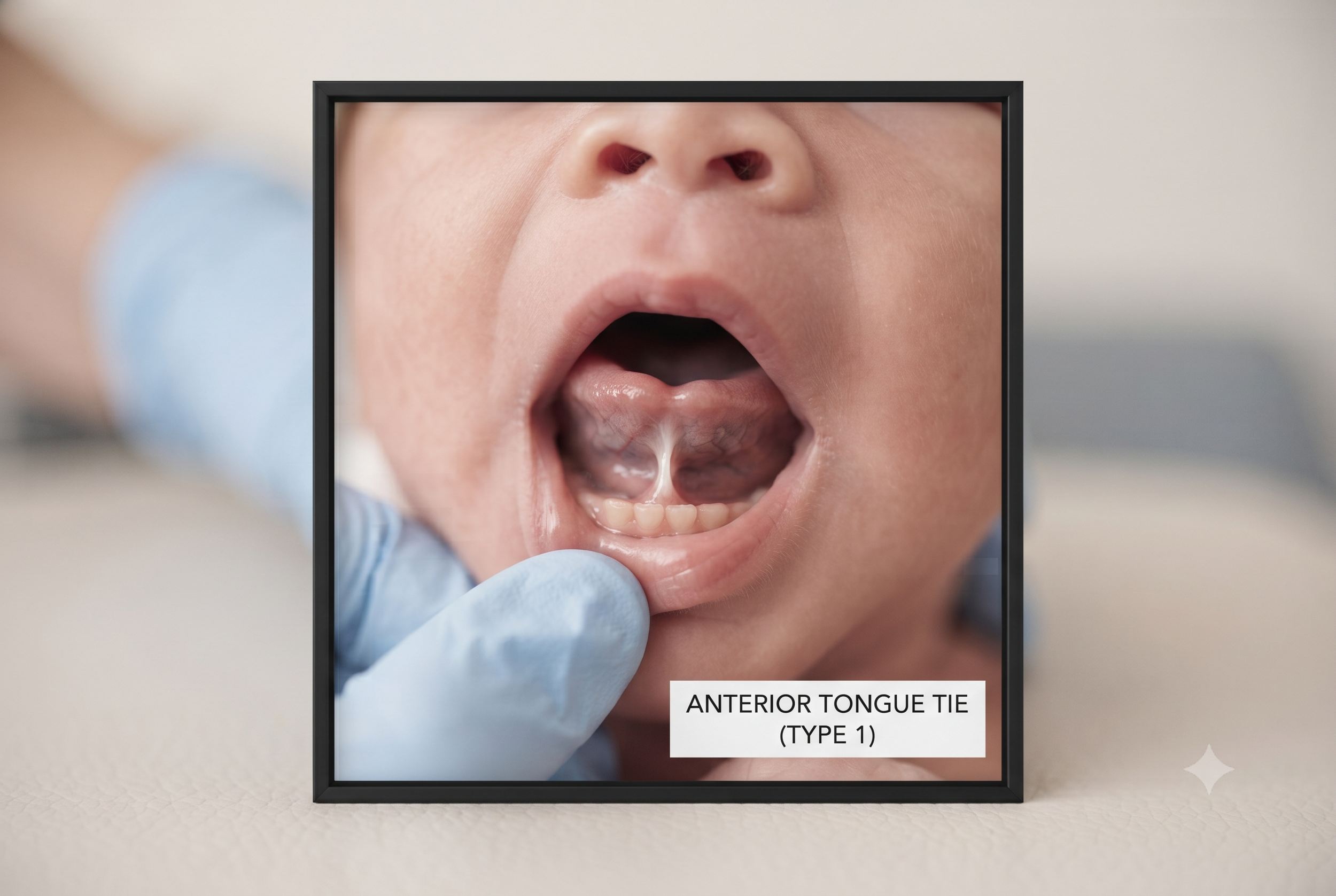
Anterior tongue tie.

Posterior tongue tie.

Kotlow.

Coryllos.

Frenotomy.

Frenuloplasty.

And perhaps the biggest question of all:

"Could my baby's tongue tie be contributing to our feeding difficulties?"

Tongue tie is a topic that can generate a lot of conflicting information, opinions and sometimes anxiety for new parents.

The important thing to know is that a tongue tie is not simply about what a baby's tongue looks like.

The real question is whether the lingual frenulum is restricting the baby's tongue function in a way that is affecting feeding or causing other clinically significant problems.

And this is why a thorough assessment matters.


What is a tongue tie?

The medical term for tongue tie is ankyloglossia.

The lingual frenulum is the band of tissue underneath the tongue that connects the tongue to the floor of the mouth.

Everyone has a lingual frenulum.

It is a normal anatomical structure.

In some babies, however, the frenulum is unusually tight, thick, short or positioned in a way that restricts the movement of the tongue.

When that restriction affects tongue function, the term ankyloglossia, or tongue tie, may be used.

Importantly, simply having a visible frenulum does not mean a baby has a clinically significant tongue tie.

The American Academy of Pediatrics describes symptomatic ankyloglossia as a restrictive lingual frenulum occurring alongside breastfeeding difficulties that have not improved with appropriate lactation support.


baby feeding from a bottle

What does the tongue need to do during feeding?

The tongue plays an incredibly important role in infant feeding.

During breastfeeding, the baby's tongue needs to coordinate with the lips, jaw, cheeks and palate to create an effective seal and generate the suction and compression needed to remove milk.

The tongue also needs to move in a coordinated way to help bring milk toward the back of the mouth for swallowing.

When tongue movement is restricted, some babies may compensate by using other structures more heavily — for example, increasing jaw movement or relying more on the lips.

Not every baby with a tongue restriction will have feeding difficulties.

But when the restriction is functionally significant, it may contribute to difficulties with feeding.

How can tongue tie affect breastfeeding?

Breastfeeding is a complex interaction between two people — mother and baby — so there isn't one single symptom that proves a baby has a tongue tie.

However, a restrictive tongue can sometimes contribute to:

Shallow attachment

A baby may struggle to maintain a deep, comfortable attachment to the breast.

Nipple pain

A shallow or ineffective latch can compress the nipple and contribute to significant nipple pain or trauma.

Clicking or loss of suction

Some babies may make clicking sounds during feeds or repeatedly lose their seal.

Clicking alone does not diagnose tongue tie, but it can be one piece of the overall feeding picture.

Long or exhausting feeds

A baby who is not transferring milk efficiently may spend a long time at the breast.

Frequent feeding

A baby who is taking smaller amounts of milk during each feed may want to feed again very soon.

Poor milk transfer

Restricted tongue movement may contribute to ineffective milk removal in some babies.

Breast fullness or recurrent milk stasis

If milk is not being effectively removed, the mother may experience ongoing breast fullness or other complications related to ineffective milk drainage.

Poor weight gain

In some cases, ineffective milk transfer can contribute to inadequate intake and poor weight gain.

Maternal milk supply concerns

If milk is not being removed effectively, the breasts may receive less stimulation, which can affect milk production.

However, milk supply is complex and should never automatically be attributed to tongue tie.

baby feeding from a bottle

What about bottle feeding?

Tongue tie isn't only relevant to breastfeeding.

Babies who are bottle-fed, expressed-milk-fed or combination-fed also rely on coordinated oral movements to feed effectively.

A baby with restricted tongue movement may potentially experience difficulties such as:

  • Difficulty maintaining a seal around the teat

  • Milk leaking from the mouth

  • Clicking or smacking sounds

  • Frequent breaks during feeds

  • Coughing or spluttering during feeds

  • Very long feeds

  • Fatigue during feeding

  • Difficulty coordinating sucking, swallowing and breathing

  • Difficulty managing milk flow

  • Frustration during feeds

However, these signs are not specific to tongue tie.

There are many reasons a baby may struggle with bottle feeding, including teat flow, positioning, oral-motor coordination, prematurity, respiratory issues, neurological factors and other anatomical or functional differences.

This is why a feeding assessment is much more useful than simply looking underneath the tongue.


Anterior vs posterior tongue tie

You may have heard the terms anterior tongue tie and posterior tongue tie.

These terms are commonly used in clinical conversations, but they can be confusing.

Anterior tongue tie

An anterior tongue tie is generally more obvious.

The frenulum attaches closer to the front or underside of the tongue and may be visible when the tongue is lifted.

In some babies, the restriction is relatively easy to see.

Parents may notice that when their baby tries to stick their tongue out, the tongue tip appears notched, heart-shaped or unable to extend normally.

However, appearance alone doesn't tell us how significantly the tongue is functioning.

What is a posterior tongue tie?

A posterior tongue tie is a term commonly used when the restrictive tissue is located further back underneath the tongue and the restriction may not be immediately obvious when looking at the tongue tip.

The term is widely used by lactation professionals and some clinicians, but there is ongoing debate about terminology, diagnostic criteria and what constitutes a clinically significant posterior tongue tie.

This is important because families can sometimes be told that their baby has a "posterior tongue tie" simply because feeding is difficult.

Feeding difficulties should not automatically be interpreted as evidence of a posterior tongue tie.

Instead, the baby's oral anatomy and functional feeding ability need to be assessed together.

Are there different classifications of tongue tie?

Yes.

Several classification systems have been developed to describe the appearance and/or function of the lingual frenulum.

You may hear clinicians refer to systems such as:

Coryllos classification

This system broadly categorises the anatomical location of the frenulum, from more obvious anterior attachments through to deeper posterior attachments.

Kotlow classification

The Kotlow system attempts to classify tongue tie according to the distance from the tongue tip to the frenulum attachment.

Hazelbaker Assessment Tool for Lingual Frenulum Function (HATLFF)

This assessment considers both appearance and function, including aspects of tongue movement and feeding-related function.

There are also other assessment tools and clinical approaches.

However, there is an important limitation:

There is no single universally accepted classification system or diagnostic tool that can, on its own, tell us whether a baby needs a frenotomy.

The Academy of Breastfeeding Medicine notes that tongue-tie assessment tools vary considerably and that no tool should be used as the sole basis for deciding whether a frenotomy is indicated.

This is why you may receive slightly different descriptions from different practitioners.

So how is tongue tie actually diagnosed?

This is perhaps the most important part.

Tongue tie should be assessed by looking at both anatomy AND function.

A good assessment should not simply involve someone lifting your baby's tongue and saying:

"Yes, that's a tongue tie."

Instead, assessment should consider your baby's:

  • Oral anatomy
  • Tongue appearance
  • Tongue elevation
  • Tongue extension
  • Tongue lateralisation
  • Tongue cupping and movement
  • Suck pattern
  • Jaw movement
  • Ability to maintain suction
  • Feeding behaviour
  • Milk transfer
  • Weight gain
  • Overall feeding history

For breastfeeding families, a skilled clinician should ideally watch the baby feed.

The Academy of Breastfeeding Medicine recommends a detailed breastfeeding assessment that includes maternal and infant history, physical examination and direct observation of breastfeeding, including assessment of maternal comfort and milk transfer.

midwife or IBCLC supporting a breastfeeding mother

Why watching a feed is so important

A baby's tongue can look restricted but function beautifully.

Another baby may have a less obvious restriction but experience significant functional difficulties.

This is why a photograph or quick oral examination cannot tell the whole story.

Watching a feed allows the clinician to ask:

  • What is actually happening?

  • Is the baby attaching deeply?

  • Can they maintain their seal?

  • Are they transferring milk?

  • Can we hear and see effective swallowing?

  • Is mum comfortable?

  • Is the baby becoming fatigued?

  • Is the baby gaining weight appropriately?

  • Could something else be contributing to the feeding difficulty?

These questions are much more useful than simply asking:

"Does my baby have a frenulum?"

What if my baby has a tongue tie but is feeding well?

This is an important question.

If your baby has a visible frenulum but is:

  • Feeding comfortably
  • Transferring milk effectively
  • Gaining weight appropriately
  • Maintaining an effective latch
  • And you are not experiencing significant feeding problems

There may be no reason to intervene simply because a frenulum is present.

The lingual frenulum is a normal anatomical structure.

The presence of a frenulum alone is not an indication for surgery.

This is why families should be given information about both treatment and non-treatment options.

What are the options if my baby has a tongue tie?

If a restrictive frenulum is identified, there isn't necessarily only one option.

Your options may include:

1. Continue with conservative management

This may be appropriate when feeding is progressing well or when the feeding difficulties can be managed without surgery.

Support may include:

  • Optimising positioning
  • Improving latch
  • Feeding frequency adjustments
  • Milk supply support
  • Expressing
  • Temporary supplementation where clinically indicated
  • Nipple shields in selected circumstances
  • Monitoring weight
  • Follow-up feeding assessments

The Academy of Breastfeeding Medicine recognises that skilled lactation support can resolve or improve many breastfeeding difficulties without surgery.

2. Monitor and reassess

Sometimes the best approach is simply to give your baby time.

Babies grow.

Their mouths change.

Their oral-motor skills develop.

Their feeding skills mature.

A baby who is struggling in the early days may feed much more effectively with growth and skilled support.

If you choose not to proceed with a release immediately, you should still have access to appropriate follow-up so that feeding can be reassessed if problems continue.

3. Frenotomy

A frenotomy is a procedure where the restrictive lingual frenulum is released.

In young infants, this is generally a relatively quick procedure performed by an appropriately trained medical or dental practitioner.

The aim is to release the restriction and improve tongue movement.

However, frenotomy should not be presented as a guaranteed solution to breastfeeding difficulties.

The evidence suggests that frenotomy can reduce maternal nipple pain in the short term, but evidence for consistent improvement in infant feeding is less certain. The Cochrane review found methodological limitations and insufficient evidence regarding long-term breastfeeding outcomes.

The decision to proceed should therefore involve an informed discussion about:

  • Your baby's feeding difficulties
  • The functional findings
  • Potential benefits
  • Potential risks
  • Alternative approaches
  • What follow-up support will be available
gentle professional infant assessment

Scissors or laser?

You may also hear parents discussing whether a tongue tie should be released using scissors or laser.

Both approaches are used by clinicians.

However, there is not good evidence demonstrating that one method is universally superior for infants with tongue tie.

The Academy of Breastfeeding Medicine notes that scissors remain a long-established method and that other instruments, including lasers, are also used, but published comparative studies between the different instruments are lacking.

The most important considerations are the clinician's training and experience, appropriate assessment, informed consent, safe technique and appropriate follow-up.

Does every tongue tie need to be released?

No.

A tongue tie should not be treated simply because it can be seen.

The question is whether there is a functional restriction causing clinically significant problems and whether those problems have been appropriately assessed and supported.

The AAP notes that fewer than half of infants with physical findings consistent with ankyloglossia have breastfeeding difficulty, reinforcing why anatomy alone should not determine treatment.

What happens if you decide to have the tongue tie released?

If frenotomy is recommended and you decide to proceed, your baby's treating practitioner should explain:

  • What the procedure involves
  • How it will be performed
  • Expected benefits
  • Potential risks
  • Pain management
  • Feeding immediately afterwards
  • Wound care
  • Follow-up arrangements
  • What symptoms should prompt medical review

It is also worth arranging appropriate feeding support around the procedure.

The release addresses the restriction — but your baby may still need help learning to feed with their new range of tongue movement.

This is why post-release lactation support can be so valuable.

A tongue tie is only one piece of the feeding puzzle

This is perhaps the most important message of all.

If your baby is struggling to breastfeed or bottle-feed, we shouldn't automatically assume that tongue tie is the answer.

There are many possible contributors to feeding difficulties.

A comprehensive assessment considers the whole baby and the whole feeding relationship.

Sometimes a tongue tie is significant.

Sometimes the frenulum is completely normal.

Sometimes there is a restriction but it isn't causing the feeding problem.

And sometimes there are several contributing factors.

The goal isn't simply to find a tongue tie.

The goal is to understand why your baby is struggling to feed and determine what support will help.

Where does an IBCLC fit into tongue-tie care?

An IBCLC can play an important role in assessing the feeding relationship before and after a tongue tie diagnosis.

This may include assessing:

  • Breastfeeding history

  • Bottle feeding where relevant

  • Latch

  • Positioning

  • Sucking pattern

  • Milk transfer

  • Maternal comfort

  • Milk supply

  • Infant weight and growth

  • Oral function

  • Feeding efficiency

  • The impact of any suspected tongue restriction

An IBCLC does not replace the medical or dental practitioner who diagnoses and performs a frenotomy.

Instead, good care is collaborative.

The IBCLC can assess feeding and lactation, while the appropriately qualified medical or dental practitioner can assess the anatomical restriction and discuss procedural options.

If you're wondering whether your baby has a tongue tie…

You don't need to become an expert in tongue-tie classifications before asking for help.

You don't need to know whether your baby's frenulum is "Type 3" or "Type 4."

And you don't need to decide immediately whether your baby should have a frenotomy.

Start with the feeding.

How is your baby feeding?

How comfortable are you?

Is your baby transferring milk effectively?

Is your baby growing appropriately?

What does your baby's tongue actually do during feeding?

These questions provide much more meaningful information than anatomy alone.

calm parent + newborn image

You have options 🤍

If your baby has been diagnosed with tongue tie, it is completely understandable to feel overwhelmed.

You may hear one person say:

"It definitely needs to be released."

Another may say:

"I wouldn't touch it."

And suddenly you're left wondering who is right.

The answer isn't always black and white.

There are different approaches, and the right decision depends on your baby's individual anatomy, function, feeding difficulties, growth, your goals and the advice of appropriately qualified healthcare professionals.

You deserve clear information, evidence-informed care and the opportunity to make an informed decision without pressure.

If your baby is struggling with breastfeeding or bottle feeding and you're wondering whether tongue tie may be contributing, a comprehensive feeding assessment is a good place to start.

Sometimes the answer is tongue tie.

Sometimes it isn't.

And sometimes the answer is a combination of several things.

Either way, you don't have to work it out alone. 🤍

Concerned your baby's tongue tie may be affecting feeding?

Book a comprehensive lactation consultation with Jess, IBCLC & Endorsed Midwife.

We can assess feeding, latch, milk transfer and your baby's oral function and help you understand your options.

BOOK A DISCOVERY CALL

Medical Disclaimer

This article is intended for general educational purposes and does not replace individual medical, dental or lactation assessment. Tongue tie diagnosis and treatment should be individualised. If you are concerned about your baby's feeding, weight gain, hydration, breathing, swallowing or general wellbeing, seek assessment from an appropriately qualified healthcare professional.

Next
Next

When Birth Happens Earlier Than Expected: How Private Midwifery Care Can Support You Through Premature Birth